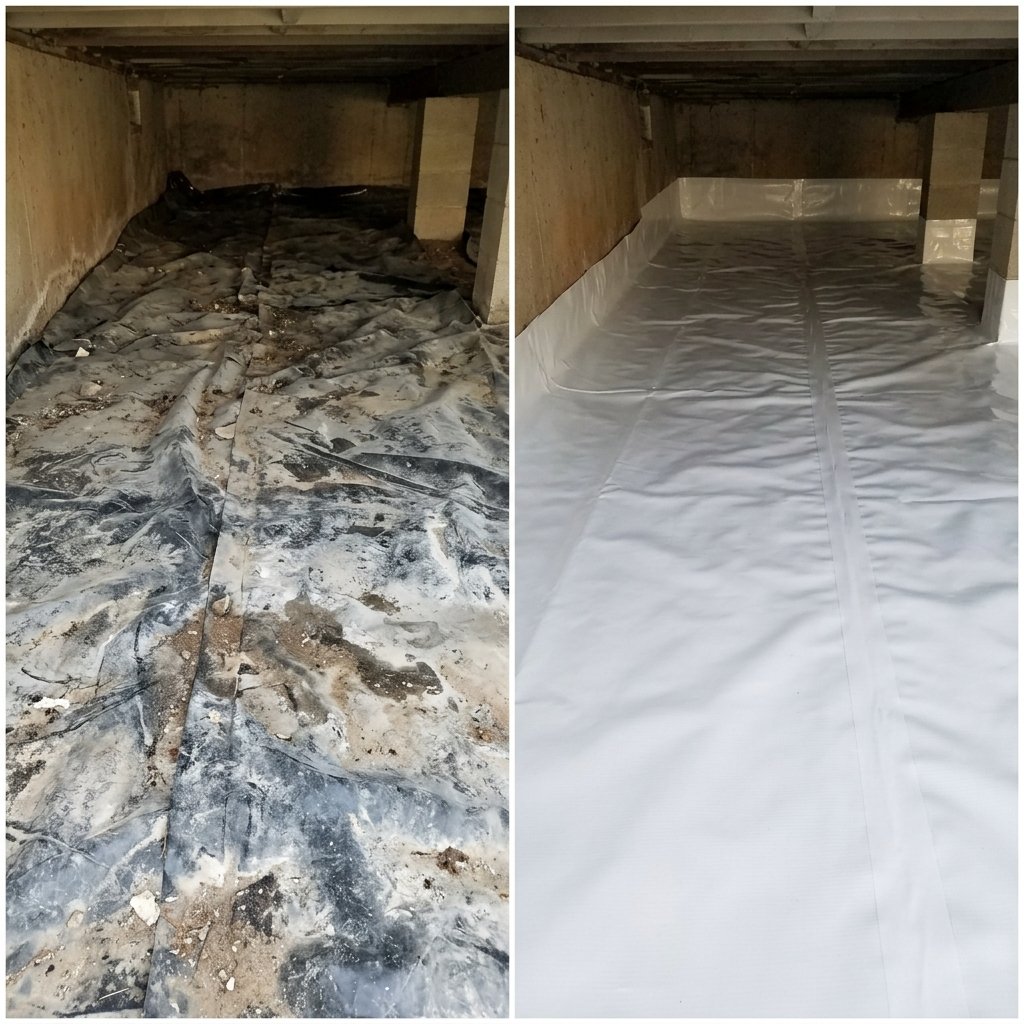
The soil beneath your home constantly releases moisture into the air. A properly installed vapor barrier is the single most important defense between that moisture and your joists, insulation, and indoor air.
Even on a perfectly dry day, the soil under your home is releasing water vapor constantly through a process called evapotranspiration. In Middle Tennessee, where the water table is high and rainfall averages nearly 50 inches per year, that moisture load is substantial. Without a vapor barrier, every bit of it rises directly into your crawlspace and eventually into your home.
The damage is slow, invisible, and cumulative — which is why most homeowners don't notice it until they're looking at rotted joists, persistent mold, or a musty smell that won't go away no matter how many times they clean.
The hardware store sells 6-mil poly sheeting. We install a professional system designed to last decades, not years.
More than three times thicker than basic poly sheeting. Puncture-resistant, tear-resistant, and designed to hold up under foot traffic during annual maintenance visits.
Our liner is treated to resist mold, bacteria, and mildew growth on the barrier surface itself — preventing it from becoming a food source.
We run the liner up the foundation walls and fasten it to the rim joist — creating a continuous seal, not just a floor cover that moisture migrates around.
Every support pier and column is wrapped and sealed individually. Gaps around piers are one of the most commonly skipped steps in DIY installs.
Overlapping seams are sealed with moisture-proof tape and mechanically fastened — not just overlapped and left to shift over time.
Where bulk water is present, we install drainage matting beneath the barrier to channel water to a sump system rather than pooling under the liner.
Vapor barrier installation is also available as part of a full encapsulation package — and when bundled, the total cost is less than buying each service separately.
A vapor barrier is the liner — the physical membrane that covers the floor and walls. Encapsulation is the complete system: vapor barrier + sealed vents + dehumidifier + sealed access door. A vapor barrier is the most important component of encapsulation, but encapsulation is more than just the barrier.
You can, but 6-mil poly tears easily, doesn't cover walls, and typically isn't sealed at seams or piers. It reduces ground vapor modestly but doesn't create a true moisture barrier. In a few years it's usually shredded and bunched — doing very little. The cost difference between DIY poly and professional 20-mil liner is small compared to the performance difference.
In Middle Tennessee — almost always yes. A vapor barrier stops ground moisture but doesn't address humidity that enters through foundation vents or via air infiltration. A dehumidifier handles what the barrier can't, keeping humidity below 55% year-round.
Key signs: visible tears or holes, bunched or displaced sections, mold growth on or under the liner, persistent musty odors, or a liner that's clearly less than 10-mil thick. We'll assess it during your free inspection and tell you honestly whether it needs replacement or just repair.